· 7 min read
Sliding Glass Partition Doors: Options, Acoustics and Hardware
Sliding glass doors for office and home partitions: single, double and pocket sliders, soft-close tracks, framed vs frameless, acoustic limits and accessibility.
Key takeaways
- Sliding doors save floor space where a swinging door would get in the way.
- Soft-close tracks and good hardware make heavy glass easy to move.
- Sliding doors seal less well than hinged doors, which limits acoustics.
- Framed sliders give better privacy than frameless ones.
When to choose a sliding glass door
A sliding door suits tight corridors, small meeting rooms, pods and rooms where furniture sits close to the door. It also makes a wide opening possible, for example between a meeting room and a breakout area that are sometimes used together.
For other door types, see our glass office doors guide, and for planning rooms on a floor, our office glass partitions hub.
Types of sliding glass door
- Single sliding door on a face-fixed or concealed top track
- Bi-parting double sliders for wide openings
- Telescopic sliders for very wide openings with limited stacking space
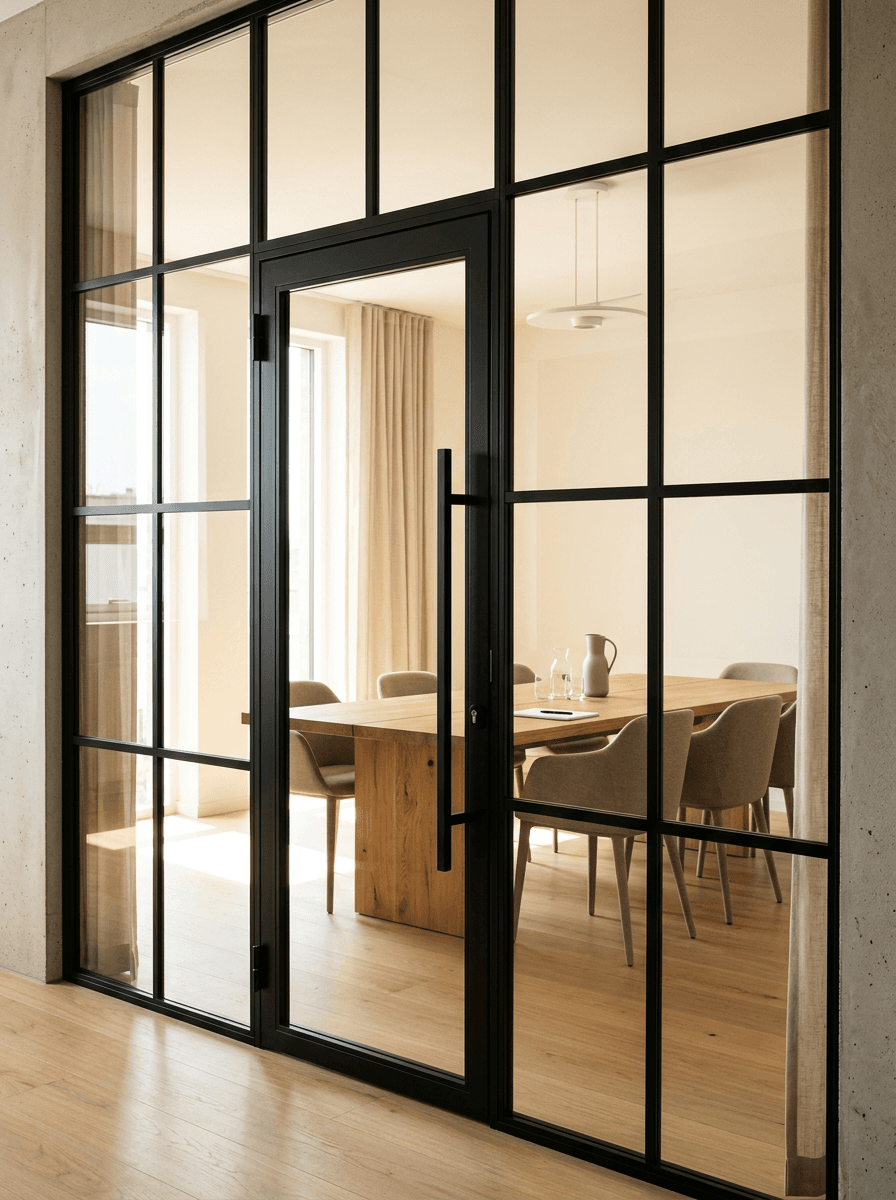
- Framed sliders in black or aluminium frames to match the partition
- Automatic sliding doors for high-traffic or accessible entrances
Sliding doors and acoustics
The gap needed for a door to slide makes it harder to seal than a hinged door. A frameless sliding door has little acoustic value. Framed sliding doors with brush or compression seals perform better, but they rarely match a hinged acoustic door.
If a room needs real speech privacy, a hinged or pivot door with perimeter and drop-down seals is the safer choice. The Rw ratings guide explains why the door matters so much.
Hardware and accessibility
Good hardware makes the difference between a door that glides and one that drags. Soft-close and soft-open dampers stop heavy glass slamming. Flush pulls and clear manifestation help people see and use the door safely, and opening forces should suit people with limited strength.
Track and gear options
Sliding doors run on a top track, either visible on the face of the partition or concealed within the head profile. Face-fixed tracks are simpler and suit retrofit; concealed tracks look cleaner but need coordination at design stage. A floor guide keeps the leaf stable without a raised track. Soft-close and soft-open dampers stop the leaf slamming at either end, which matters with heavy glass.
When a sliding door is the right choice
Sliding doors work well where:
- Corridor width or furniture prevents a door swing.
- Rooms are used for collaboration rather than confidential talks.
- A wide opening is needed, using bi-parting or telescopic leaves.
- Accessibility benefits from no swing into the approach route.
Limitations to be aware of
Sliding doors are harder to seal acoustically than hinged doors and are generally not suitable for fire-rated routes unless a tested sliding fire door set is used. Automatic sliding doors need power and controls coordinated with the electrical contractor. For confidential rooms, compare options in the glass office doors guide.
Questions
Are sliding glass doors soundproof?
Not fully. Framed sliders with seals reduce noise, but hinged acoustic doors give much better privacy.
Can a sliding door lock?
Yes. Hook locks and floor-mounted locks are available for most sliding glass doors.
Can sliding glass doors be locked?
Yes. Floor locks, hook locks and access-controlled options are available depending on the system.