· 8 min read
Fire Rated Glass Partitioning: A Plain-English Guide
What fire rated glass partitions are, the difference between integrity (E) and insulation (EI) ratings, where they are needed and what evidence to ask for.
Key takeaways
- A fire rating applies to the whole tested assembly, not just the glass.
- E ratings stop flames and smoke; EI ratings also limit heat transfer.
- The building’s fire strategy decides where fire-rated glazing is needed.
- Always ask for test evidence covering the exact configuration installed.
What is fire rated glass partitioning?
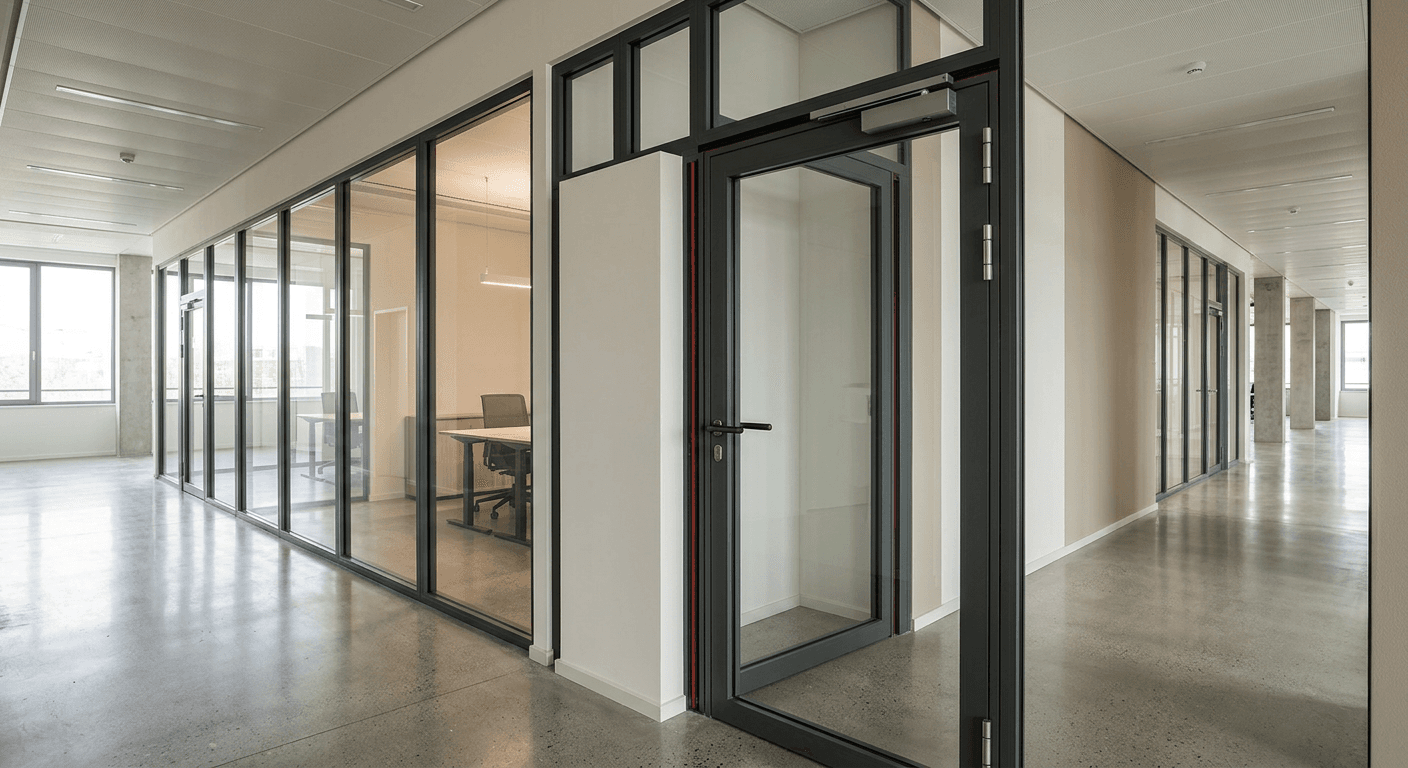
Fire rated glass partitioning is a glazed wall system tested to resist fire for a stated period, usually 30 or 60 minutes. It lets corridors, stairs and compartments stay bright and open while still protecting escape routes. It sits within the wider family of systems on our glass partition walls hub.
The rating belongs to the whole assembly: glass, frame, seals, fixings and doors, installed as tested. Swapping any component, or installing differently, can invalidate it.
E vs EI ratings
Integrity (E) means the partition stops flames and hot gases passing through for the rated period. Integrity and insulation (EI) means it also limits the temperature on the unexposed face, so people can pass close by safely and combustible materials nearby will not ignite. EI glass is thicker, heavier and more expensive.
| Rating | What it means | Typical use |
|---|---|---|
| E30 / E60 | Integrity for 30 or 60 minutes | Some corridor and screen applications |
| EI30 / EI60 | Integrity and insulation for 30 or 60 minutes | Escape routes, protected corridors, compartments |
The fire engineer or building control decides the required rating, not the glazing supplier.
Where fire-rated glazing is needed
Typical locations include protected corridors and lobbies, walls adjoining stairs and lift cores, and partitions forming fire compartments. In offices, a meeting room on an escape corridor may need its corridor wall fire-rated even if the other walls do not.
Fire doors in glass partitions
Glazed fire doors must be tested doorsets with compatible frames, intumescent seals, self-closers and certified ironmongery. They also need regular inspection once in use.
Evidence to ask for
Ask for test reports or assessments covering the configuration being installed, including pane sizes, frame type and door. Installer certification and handover documentation should follow. For commercial specification detail, see fire rated glass partitioning in commercial fit-outs.
Questions
Can frameless partitions be fire rated?
Some systems with tested butt joints are available, but most fire-rated partitions use frames for reliable performance.
Can existing partitions be upgraded to fire-rated?
Generally no. The rating depends on the whole tested assembly, so fire-rated performance usually means a new system.