· 7 min read
Glass Office Doors: Hinged, Sliding and Framed Options
A guide to glass office door types — frameless hinged, framed hinged, sliding and pivot — and how to choose hardware, seals and locks.
Door types
The most common options are:
- Frameless hinged — minimal, suits frameless partitions.
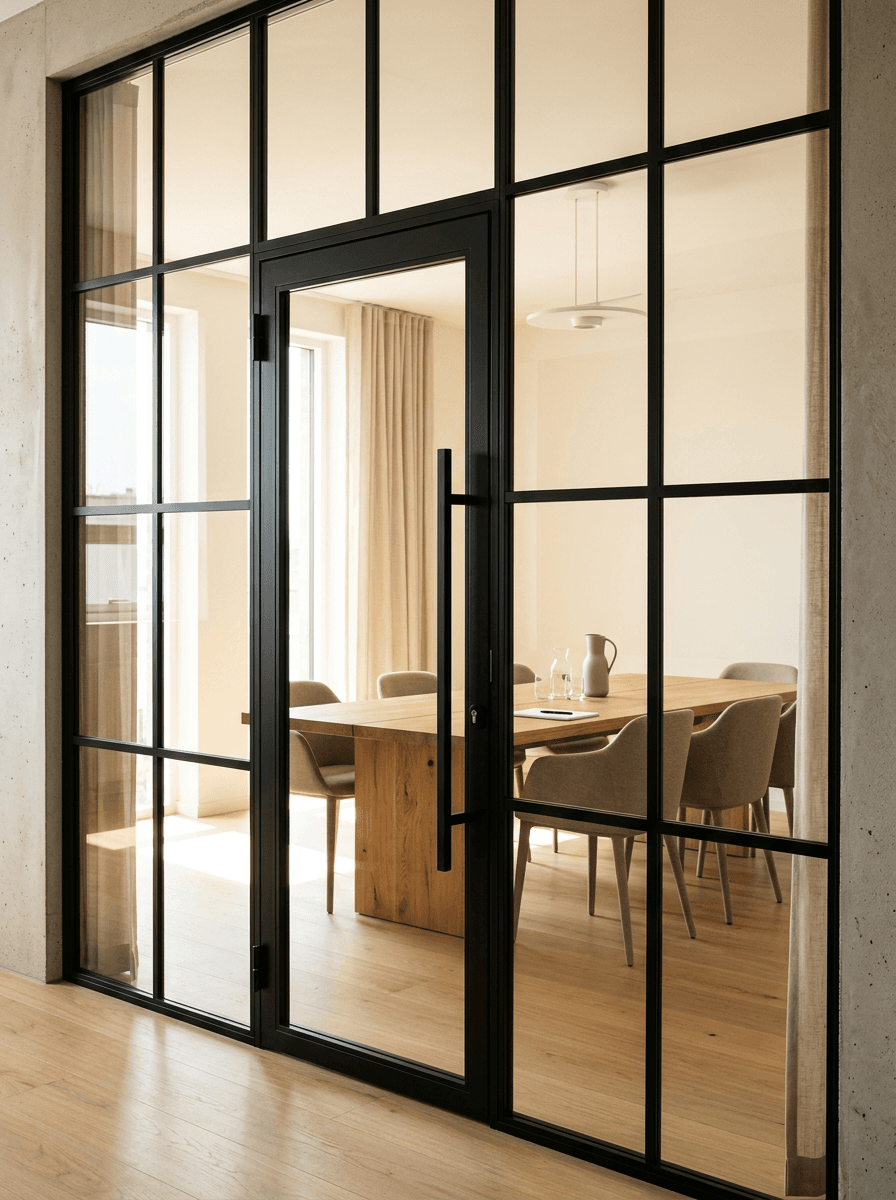
- Framed hinged — robust, better seals, suits black-framed systems.
- Sliding — saves space where swing clearance is limited.
- Pivot — larger feature doors for receptions and boardrooms.
Hardware matters
Hinges, closers and handles affect how a door feels every day. Choose hardware rated for the door weight and expected use, and consider accessibility requirements for handle heights and opening forces.
Matching the door to the room
The door is the most-used part of any glass partition, so it deserves as much thought as the wall. A busy breakout area needs a door that is easy to open and robust. A confidential HR room needs the best possible seals. A small focus room in a narrow corridor may need a sliding door simply because there is no space for a swing.
Sliding doors in more detail
Sliding doors can be face-mounted on a visible track or concealed within the head of the partition. Soft-close dampers prevent slamming and make heavy glass leaves feel light. The trade-off is acoustics: because a sliding leaf moves past the partition, sealing it fully is difficult. Sliding doors suit collaboration spaces better than confidential meeting rooms. See our sliding glass partition doors guide.
Locks, access control and accessibility
Practical requirements often decide the hardware:
- Locks can be patch locks on frameless doors or mortice locks in framed doors.
- Access control and electric strikes are easier to integrate into framed doors.
- Lever handles and pull handles should be sized and positioned for accessible use.
- Closers should be adjusted so opening forces suit all users, in line with Approved Document M guidance.
- Vision panels and manifestation must make glass doors clearly visible.
Doors as a design feature
Feature doors can define an entrance. Oversized pivot doors suit receptions, while black steel-look double doors bring character to boardrooms. Explore our steel and glass doors for decorative options with industrial styling.
Hardware and accessibility
Door hardware affects both everyday use and accessibility. Lever or pull handles should be easy to grip, closers should not be too heavy, and clear opening widths need to suit wheelchair users where required. For busy meeting rooms, soft-close sliding gear or floor springs with hold-open functions reduce wear. Glass doors also need clear manifestation at eye level so they are easy to see.
Questions
Can a glass office door be fire rated?
Yes, fire-rated glass doors are available in framed systems, tested as a complete door set with matching frames, hardware and seals.
How long do glass door hinges and closers last?
Good-quality hardware lasts many years in normal office use. Periodic adjustment keeps doors closing correctly; heavy-use doors may need closers replacing over time.