· 6 min read
Are Glass Partitions Good for Office Privacy?
How glass partitions handle visual and acoustic privacy, and the specification choices that make glazed rooms suitable for confidential work.
Two kinds of privacy
Privacy has two parts: visual (can people see in?) and acoustic (can people hear?). Glass partitions address each differently, and it helps to treat them separately.
Visual privacy
Visual privacy can be improved without losing light using:
- Frosted, gradient or patterned window films.
- Reeded, fluted or satin glass.
- Integral blinds within double-glazed systems.
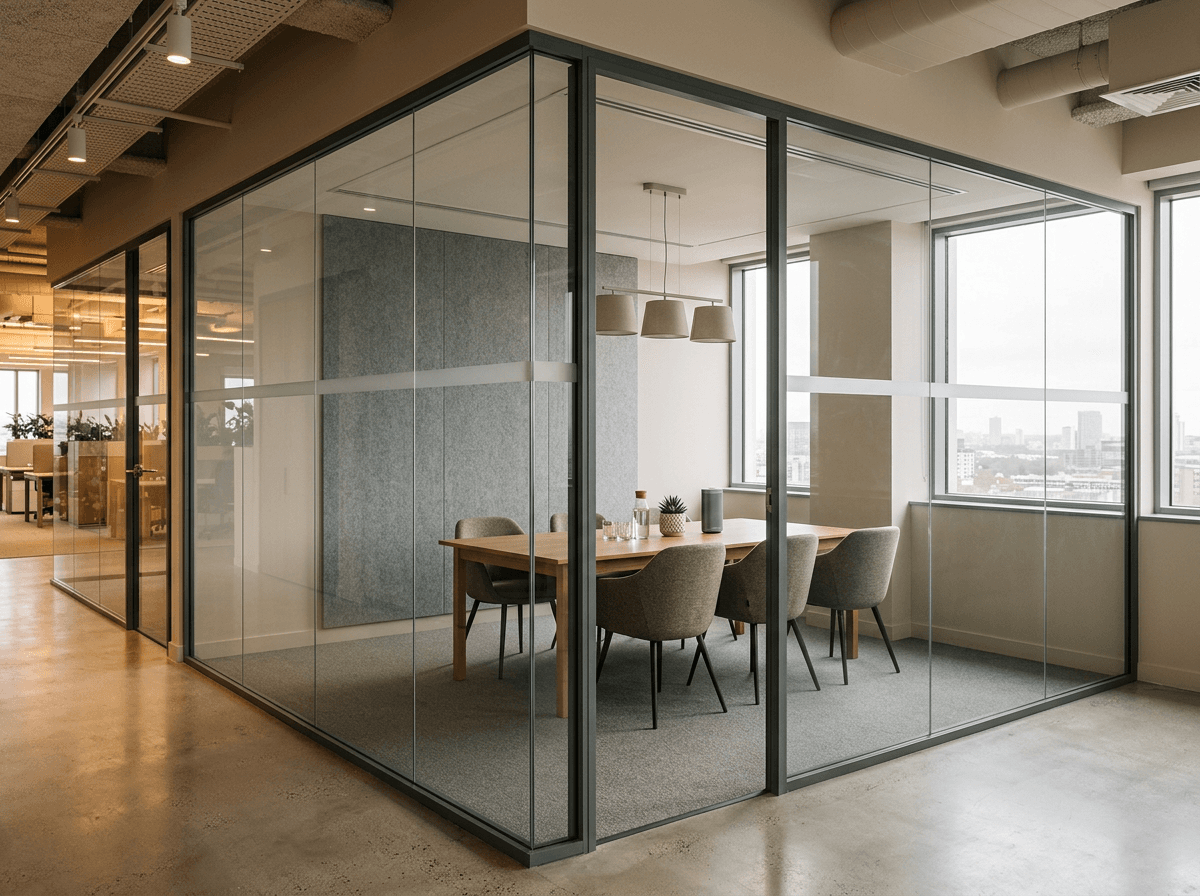
- Strategic placement of manifestation bands at eye level.
Acoustic privacy
Acoustic laminated glass, double-glazed systems and sealed doors significantly reduce sound transfer. Equally important is the ceiling void: if sound can travel over the partition, the glass specification alone won’t solve it.
Two kinds of privacy
Office privacy has two separate parts: visual privacy, meaning whether people can see in, and speech privacy, meaning whether they can hear what is said. Glass partitions can handle both, but the solutions are different and one does not fix the other. Frosted film blocks the view but does nothing for sound; acoustic glass blocks sound but remains clear.
Solving visual privacy
Options range from simple to fully adjustable:
- Frosted or patterned manifestation bands at seated eye level.
- Full-height frosted film or acid-etched glass for permanent privacy.
- Integral blinds sealed inside double-glazed units, which never need cleaning.
- Switchable smart glass that turns opaque at the press of a button. Compare options in our smart glass vs privacy film guide.
Solving speech privacy
Speech privacy depends on the glass build-up, the door and the details around the partition. Acoustic laminated glass, double-glazed systems, sealed doors and ceiling void barriers all contribute. For most meeting rooms, a well-sealed acoustic laminated system gives conversational privacy; for confidential rooms, double glazing is usually recommended. Our soundproof meeting room glass guide sets out typical targets.
In open-plan areas, sound masking — a low background sound played through ceiling speakers — can make nearby conversations much harder to follow and complements glass rooms well.
Balancing privacy with openness
The reason most businesses choose glass is to share daylight and keep a connected feel. Rather than frosting every room, it is usually better to frost only the band where people sit, keep the upper glazing clear for light, and reserve full privacy for a small number of sensitive rooms.
Questions
Can people see through glass partitions at night?
Yes. When a room is lit and the corridor is darker, the room becomes very visible. Blinds or switchable glass are the best choice where evening privacy matters.
Is frosted film a permanent solution?
Good-quality film lasts many years, can be replaced if damaged and is easy to remove when rooms change use, which makes it a flexible choice for leased offices.