· 9 min read
Acoustic Glass Partitions: What Businesses Should Know
What affects the acoustic performance of glass partitions, how ratings work, and how to set realistic expectations for meeting room privacy.
Lab ratings vs real rooms
Manufacturers publish acoustic ratings measured in laboratory conditions. On site, performance is affected by flanking paths — ceiling voids, floor voids and wall junctions — so achieved results are typically lower than laboratory figures.
What improves performance
The most effective measures usually combine:
- Acoustic laminated or double-glazed construction.
- Framed doors with perimeter and drop-down seals.
- Ceiling void barriers above the partition line.
- Sealed junctions at walls and mullions.
What an acoustic rating actually measures
Acoustic performance for partitions is usually quoted as Rw, the weighted sound reduction index. It is a single number in decibels, measured in a laboratory between two isolated test chambers to ISO 10140-2 (opens in a new tab) and rated to ISO 717-1 (opens in a new tab), that describes how much airborne sound the construction blocks across the speech frequency range. A higher number means more privacy.
Because the decibel scale is logarithmic, small numbers matter. A 10 dB improvement is generally perceived as sound becoming about half as loud, so the jump from an Rw 35 partition to an Rw 45 partition is very noticeable in a meeting room. Our Rw ratings explained guide walks through what Rw 38, Rw 44 and Rw 50 sound like in practice.
Some specifications use Rw + Ctr or Rw + C. These adaptation terms adjust the figure for low-frequency noise such as traffic or music. For speech privacy between offices, Rw is normally the right reference, but if a room sits next to a plant room or a busy street, ask for the Ctr value too.
Why installed results are lower than the brochure
A laboratory test isolates the partition. A real office does not. Sound travels over the top of the partition through the ceiling void, under it through raised access floors, along the façade at mullion junctions and straight through the door seals. These flanking paths are why an Rw 44 system might achieve a field result several decibels lower once installed.
Field results are measured as DnT,w and are the figure your occupants actually experience. Setting a realistic target means agreeing what the room needs in DnT,w terms first, then choosing a partition, door and ceiling treatment that can deliver it. That is the approach we take on every acoustic glass partition project.
Choosing a target for each room
Not every space needs the same level of privacy. Over-specifying every room wastes budget; under-specifying the boardroom causes complaints on day one. A simple room-by-room schedule usually looks like this:
- Focus pods and phone booths: moderate privacy, often single acoustic laminated glass.
- Standard meeting rooms: conversational privacy, typically an acoustic laminated or high-performance single-glazed system with a sealed door.
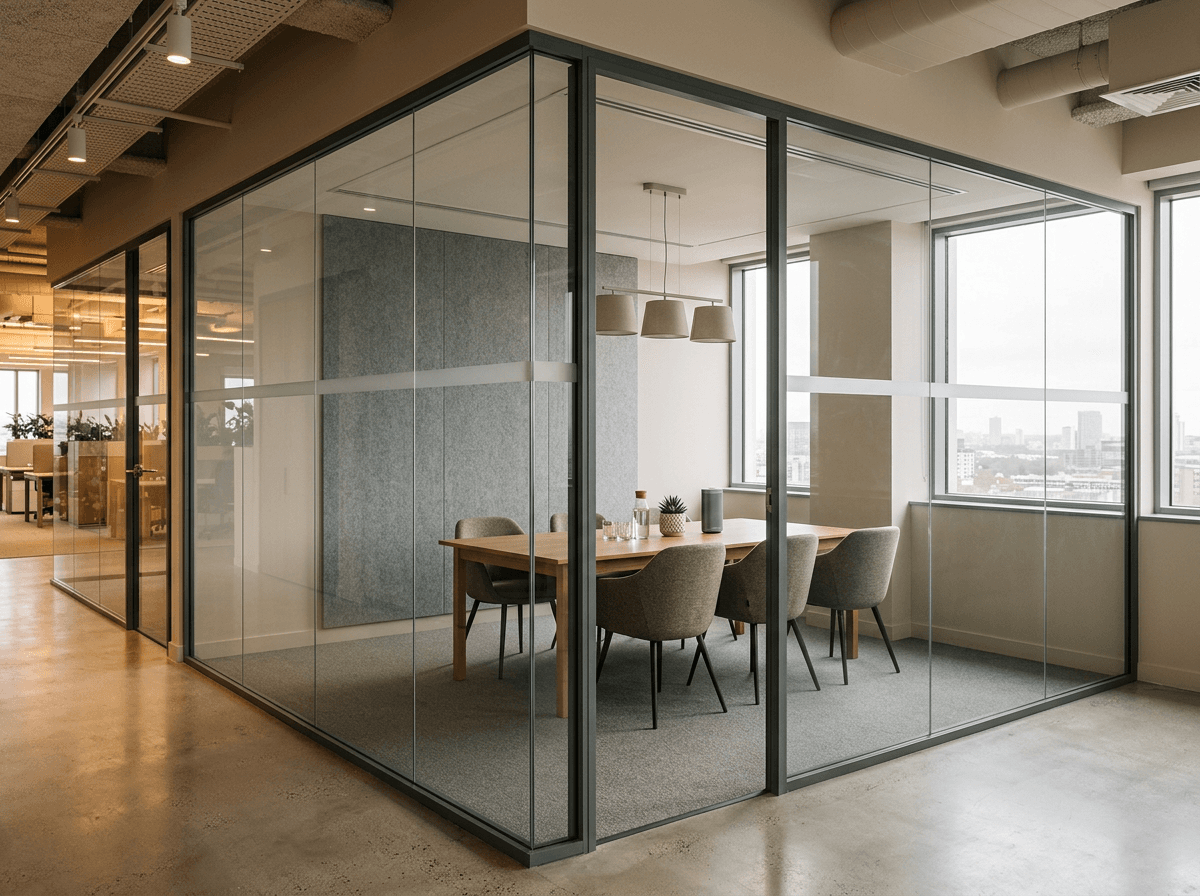
- HR, partner and boardroom spaces: confidential speech, usually a double-glazed system with a framed acoustic door and a ceiling void barrier.
- Rooms next to noisy areas such as kitchens or breakout zones: consider double glazing even if the room is small.
Doors are the weak point
A high-performance glass wall with an unsealed door performs roughly like the door. Even a small gap at the threshold lets speech through. Acoustic doors use perimeter seals, a drop-down threshold seal that lowers as the door closes and, for the highest ratings, double-glazed leaves. Sliding doors are convenient but are much harder to seal, so they are rarely right for confidential rooms. See our glass office doors guide for the trade-offs.
Questions to ask before you commit
When comparing quotes, ask each contractor to confirm:
- The tested Rw of the whole system, including the door, not just the glass.
- Whether a ceiling void barrier or plenum seal is included above each partition line.
- How junctions with the façade, columns and existing walls will be sealed.
- Whether background sound masking has been considered for open-plan areas nearby.
Questions
Will an acoustic glass partition make a room completely soundproof?
No partition is completely soundproof. Good acoustic glazing makes normal conversation unintelligible from outside the room, but raised voices or amplified sound can still be heard faintly. The aim is privacy, not silence.
Is double glazing always better than acoustic laminated single glazing?
Double glazing generally achieves higher ratings, but a well-sealed single acoustic laminated system can outperform a poorly detailed double-glazed one. The door, ceiling and junction details decide the result as much as the glass build-up.
Can existing glass partitions be upgraded acoustically?
Often, yes. Replacing door seals, adding drop-down thresholds and installing ceiling void barriers can make a noticeable difference without replacing the glass. Where the glass itself is the limit, some framed systems allow re-glazing with acoustic laminated panes.